David Russell Salmen
2014
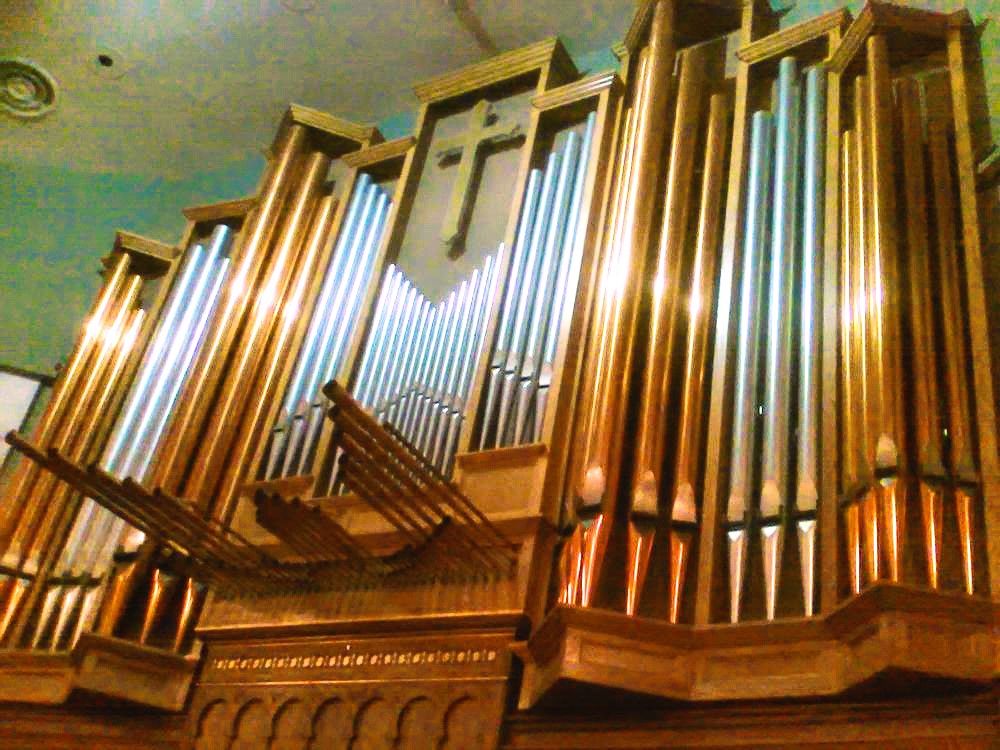
Originally Reuter Organ Co. (Opus 2074, 1984)
First United Methodist Church
Sanctuary
420 N. Nevada Avenue
Colorado Springs, CO, US
88 Ranks
EXPLORE IMAGESVIEW STOPLISTSomething not quite correct?Suggest an Edit
IMAGES
Something missing or not quite correct?Add ImageorSuggest an Edit
STOPLISTS
| Great | ||
| 16' | Violone | |
| 8' | Principal | |
| 8' | Antiphonal Principal | |
| 8' | Violone | |
| 8' | Open Flute | |
| 8' | Bourdon | |
| 5 1⁄3' | Gross Quint | |
| 4' | Octave | |
| 4' | Nachthorn | |
| 3 1⁄5' | Gross Terz | |
| 2' | Fifteenth | |
| IV | Fourniture | |
| III | Scharf | |
| 16' | Fagot | |
| 8' | Trumpet | |
| 8' | Tuba | |
| Chimes | ||
| Cymblestern |
| Swell | ||
| 16' | Lieblich Gedeckt | |
| 16' | Flauto Dolce | |
| 16' | Viole de Gambe | |
| 8' | Geigen Principal | |
| 8' | Rohrflute | |
| 8' | Lieblich Gedeckt | |
| 8' | Viole de Gambe | |
| 8' | Viole Celeste | |
| 8' | Flauto Dolce | |
| 8' | Flute Celeste | |
| 8' | Antiphonal Gedeckt | |
| 8' | Antiphonal Gemshorn | |
| 4' | Principal | |
| 4' | Hohlflute | |
| 2 2⁄3' | Nazard | |
| 2' | Blockflute | |
| 1 3⁄5' | Tierce | |
| IV | Plein Jeu | |
| 16' | Bombarde | |
| 8' | Trompette | |
| 8' | Bombarde | |
| 8' | Hautbois | |
| 8' | Vox Humana | |
| 4' | Bombarde Clarion | |
| Chimes | ||
| Tremulant |
| Choir | ||
| 8' | Antiphonal Principal | |
| 8' | Antiphonal Gedeckt | |
| 4' | Antiphonal Principal | |
| 4' | Antiphonal Gemshorn | |
| 2 2⁄3' | Antiphonal Quinte | |
| 2' | Antiphonal Rohrflute | |
| 16' | Klein Principal | |
| 8' | Geigen | |
| 8' | Voce Umana | |
| 8' | Open Flute | |
| 8' | Hohlflute | |
| 4' | Octave Geigen | |
| 4' | Harmonic Flute | |
| 2' | Super Octave | |
| III | Mixture | |
| 16' | Bassetthorn | |
| 8' | Tromba | |
| 8' | Clarinet | |
| 8' | Tuba | |
| 8' | Trompette en Chamade | |
| Tremulant |
| Positive | ||
| 16' | Lieblich Gedeckt | |
| 8' | Copula | |
| 8' | Spitzflute | |
| 4' | Principal | |
| 4' | Spillflute | |
| 2' | Principal | |
| 1 1⁄3' | Larigot | |
| 1' | Sifflute | |
| II | Sesquialtera | |
| IV | Cymbale | |
| 8' | Krummhorn | |
| 8' | Trompette en Chamade | |
| Tremulant |
| Pedal | ||
| 32' | Contra Bourdon | |
| 32' | Contra Lieblich | |
| 16' | Principal | |
| 16' | Diapason | |
| 16' | Violone | |
| 16' | Klein Principal | |
| 16' | Bourdon | |
| 16' | Lieblich Gedeckt | |
| 16' | Viole de Gambe | |
| 16' | Flauto Dolce | |
| 16' | Antiphonal Gedeckt | |
| 8' | Oktav | |
| 8' | Offenbass | |
| 8' | Violone | |
| 8' | Bourdon | |
| 8' | Lieblich Gedeckt | |
| 4' | Choral Bass | |
| 4' | Bourdon | |
| 4' | Lieblich Gedeckt | |
| 2' | Open Flute | |
| IV | Mixture | |
| 32' | Cornet VI | |
| 32' | Contra Posaune | |
| 16' | Posaune | |
| 16' | Bombarde | |
| 16' | Fagot | |
| 8' | Posaune | |
| 8' | Bombarde | |
| 4' | Posaune | |
| 4' | Bombarde | |
| 8' | Trompette en Chamade | |
| Chimes |
| Couplers | ||
| 16' | Great-Great | |
| Great U/O | ||
| 4' | Great-Great | |
| 16' | Swell-Great | |
| 8' | Swell-Great | |
| 4' | Swell-Great | |
| 16' | Choir-Great | |
| 8' | Choir-Great | |
| 4' | Choir-Great | |
| 16' | Positive-Great | |
| 8' | Positive-Great | |
| 4' | Positive-Great | |
| 16' | Swell-Swell | |
| Swell U/O | ||
| 4' | Swell-Swell | |
| 16' | Choir-Swell | |
| 8' | Choir-Swell | |
| 4' | Choir-Swell | |
| 16' | Positive-Swell | |
| 8' | Positive-Swell | |
| 4' | Positive-Swell | |
| 16' | Choir-Choir | |
| Choir U/O | ||
| 4' | Choir-Choir | |
| 16' | Swell-Choir | |
| 8' | Swell-Choir | |
| 4' | Swell-Choir | |
| 16' | Positive-Choir | |
| 8' | Positive-Choir | |
| 4' | Positive-Choir | |
| 16' | Positive-Positive | |
| Positive U/O | ||
| 4' | Positive-Positive | |
| 8' | Great-Positive | |
| 8' | Swell-Positive | |
| 8' | Choir-Positive | |
| 8' | Great-Pedal | |
| 4' | Great-Pedal | |
| 8' | Swell-Pedal | |
| 4' | Swell-Pedal | |
| 8' | Choir-Pedal | |
| 4' | Choir-Pedal | |
| 8' | Positive-Pedal | |
| 4' | Positive-Pedal |
| Accessories | ||
| Great-Choir Transfer | ||
| Pedal on Choir |
Originally Written/Published: 10/19/2014
Open In New TabSomething missing or not quite correct?Add StoplistorSuggest an Edit
CONSOLES
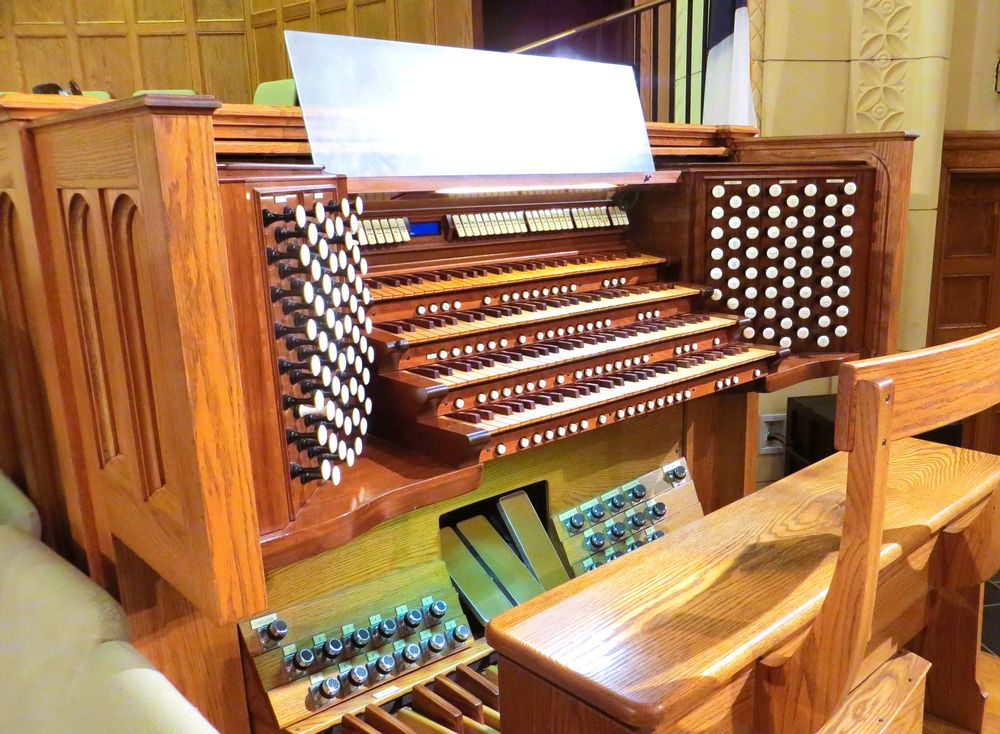
Builder: Reuter Organ Co.
Position: Movable Console
Design: Traditional With Roll Top
Pedalboard Type: Concave Radiating (Meeting AGO Standards)
Features:
4 Manuals (61 Notes)32 Note Pedal5 Divisions66 StopsElectrical Key ActionElectrical Stop ActionCrescendoSequencerCombination Thumb Piston(s)Combination Toe Piston(s)Coupler Toe Piston(s)Sforzando Thumb Piston(s)Sforzando Toe Piston(s)Stop Layout: Drawknobs in Vertical Rows on Angled Jambs
Expression Type: Balanced Expression Shoes/Pedals (Meeting AGO Standards)
Combination Action: Computerized/Digital
Control System: Unknown or N/A
Something missing or not quite correct?Add ConsoleorSuggest an Edit
DETAILS
This instrument is: ExtantandPlayable in this location
Additions/alterations to 1986 Reuter organ.
"In the recent renovation and expansion of the organ, we worked to best make the organ fill the sanctuary and support the choir across a wider range of frequency, dynamic and color. Some of the very delicate "prayer stops" of the organ that were typical of the 1950s to provide cover music, have given way to more powerful orchestral voices that will accompany the choir and work with a large orchestra in today's music program. Stops were added to the Choir division to give it a flavor found within English instruments that are specifically designed to accompany choirs. The dark, trumpet-like Tromba provides weight in the reed chorus of the organ. The Clarinet, which was of a much larger design than we have previously employed gives a rich and wooden orchestral color. The English Tuba allows for a controlled and colorful solo reed when the style of the music would be interrupted by the use of the commanding horizontal Trompette en Chamade. Much of the existing organ was revoiced to achieve better balance and blend while creating voices rich in harmonic content that will carry within the room regardless of volume level. The early solid state switching and memory system of the 1980s era has been replaced with current technology that allows transmission of data from the console to the pipe chamber through a single fiber optic line and uses a micro-processor for record/playback, transposer and increased memory and piston functions. The manual keyboards were refelted and refinished. Aging chest leather from the 1950s has been replaced to give the organ new mechanical life along with the installation of new Swell and Choir expression motors and tremulants. The organ was also completely cleaned.
An Antiphonal organ was added for increased musical flexibility. It has its own keyboard that can be used with choirs from the balcony location, or it can be played from the main console as desired. It was originally built by the Reuter Organ Company and served for many years in Protestant Chapel at BoysTown, Nebraska."
-David Salmen
Source: 2014 Organ Re-dedication booklet
Something missing or not quite correct?Add NoteorAdd WebpageorAdd Cross ReferenceorSuggest an Edit