Hook & Hastings
Opus 1980, 1902
Originally M. P. Möller (1893)
First Presbyterian Church
Sanctuary
Delaware Avenue and Sixteenth Street
Indianapolis, IN, US
EXPLORE IMAGESVIEW STOPLISTSomething not quite correct?Suggest an Edit
🤝 Instrument entries in Indiana sponsored by:
We are grateful for the generous support of our sponsors, who make it possible for us to continue our mission of preserving and promoting the rich history of pipe organs across the globe.

IMAGES
Something missing or not quite correct?Add ImageorSuggest an Edit
STOPLISTS
Something missing or not quite correct?Add Stoplist
CONSOLES
Builder: Unknown
Position: Unknown
Design: Unknown
Pedalboard Type: Unknown
Features:
3 Manuals (61 Notes)30 Note Pedal4 Divisions27 RegistersStop Layout: Unknown
Expression Type: Unknown
Combination Action: Unknown
Control System: Unknown or N/A
Something missing or not quite correct?Add ConsoleorSuggest an Edit
DETAILS
This instrument is: Extant and Playable in this location
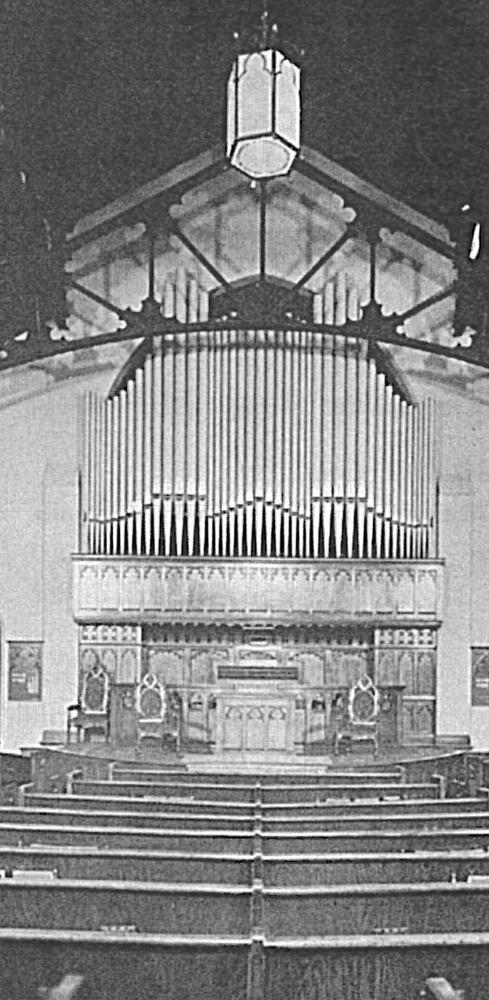
For the new church, the congregation returned to the Hook firm, known then of course as Hook & Hastings, to rebuild, enlarge, and install the organ from the old church as its opus 1980. The electric-action organ had stopknob control. Manual compass was fifty-eight notes (CC-a3); pedal (flat pedalboard) compass was twenty-seven notes (CC-d'). Initially the organ had a water motor.
The water motor was replaced by a Kinetic blower in December 1913 at a cost of $231.00, installed by Thomas H. Mielke of Indianapolis. It was designed for 3½" wind pressure.
In 1922 an anonymous donor provided funds for rebuilding the organ. This work was carried out by Mielke, who changed the pitch from concert to international, added a set of Chimes, a Vox Humana, and an Aeoline, and provided a new generator.
-- 2007 OHS Atlas
Database Manager on May 14th, 2016:
Rebuild and tonal changes in 1922 by Mielke; replaced in 1957 by 3/50 Moller Op. 9018.
Database Manager on April 11th, 2005:
Hook moved the church's previous 1871 E. & G. G. Hook, Op. 614 to a new building and reconstructed it. [ed.: not completely accurate, as Moller rebuilt that 1872 organin 1893, the degree to which is not completely clear.]
Database Manager on February 16th, 2005:
Identified from company publications as edited and expanded in The Hook Opus List 1829-1935, ed. William T. Van Pelt (Organ Historical Society, 1991).
Related Instrument Entries: E. & G. G. Hook (Opus 614, 1872) , M. P. Möller (1893) , Thomas Mielke (1922)
Something missing or not quite correct?Add NoteorAdd WebpageorAdd Cross ReferenceorSuggest an Edit