🤝 Instrument entries in California sponsored by:
We are grateful for the generous support of our sponsors, who make it possible for us to continue our mission of preserving and promoting the rich history of pipe organs across the globe.

IMAGES
Something missing or not quite correct?Add ImageorSuggest an Edit
STOPLISTS
Something missing or not quite correct?Add Stoplist
CONSOLES
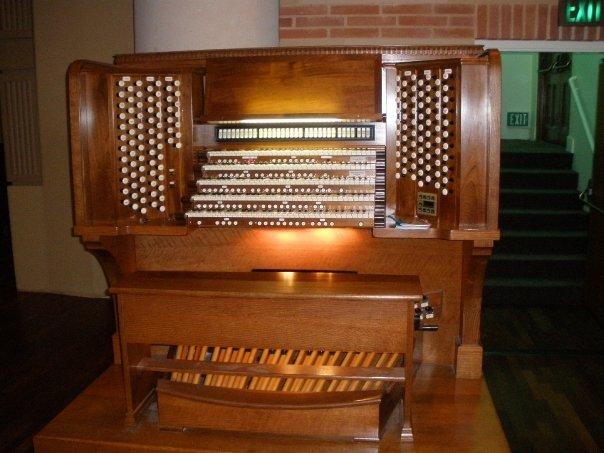
Builder: Unknown
Position: Movable Console
Design: Traditional With Roll Top
Pedalboard Type: Concave Radiating (Details Unknown)
Features:
5 Manuals (61 Notes)32 Note Pedal6 Divisions115 StopsElectrical Key ActionElectrical Stop ActionSequencerCombination Thumb Piston(s)Combination Toe Piston(s)Stop Layout: Drawknobs in Vertical Rows on Angled Jambs
Expression Type: Balanced Expression Shoes/Pedals (Details Unknown)
Combination Action: Computerized/Digital
Control System: Unknown or N/A
Something missing or not quite correct?Add ConsoleorSuggest an Edit
DETAILS
This instrument is: Extant and Playable in this location
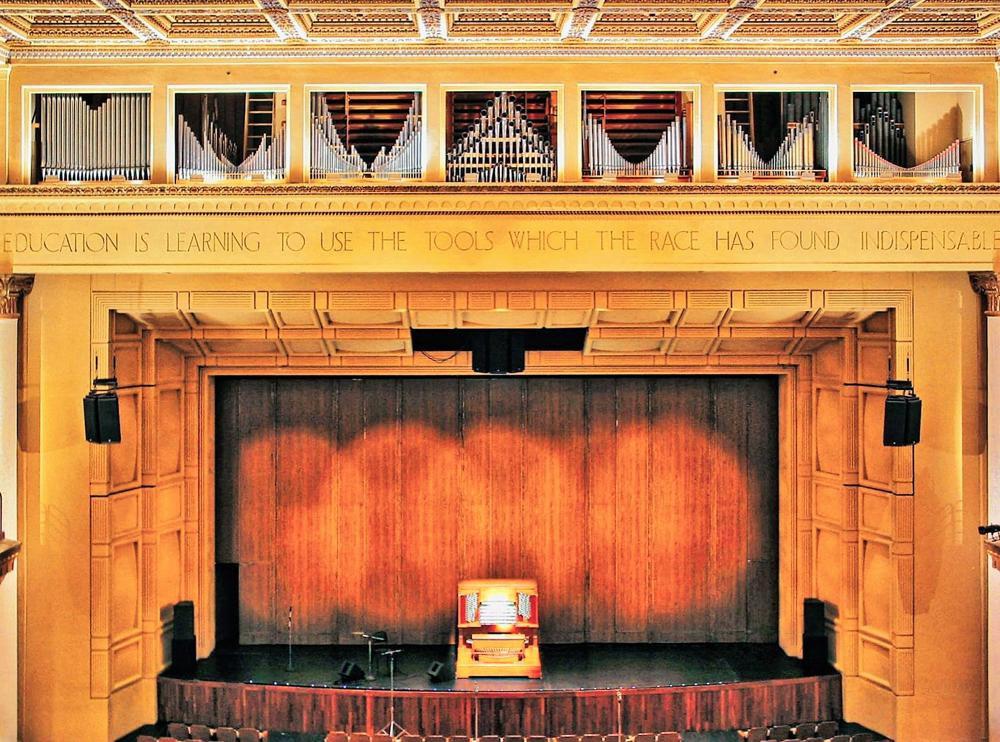
Updated through online information from Richard Harrold. -- HISTORICAL INFORMATION (also taken from the tech-spec PDF and corrected of errors): The Royce Grand Pipe Organ is here due in large part because of the generosity of the Harvey Mudd family and the vision of the University Provost Ernest Carroll Moore. Provost Moore enlisted Harold Gleason to design and install the instrument. The original side chambers were too small to house the organ as designed by Gleason and he persuaded the architects to allow the pipes to be placed over the proscenium arch. Installation and tuning was completed in the summer of 1930 and the inaugural concert was given by Gleason on Sept 9, 1930.
Alexander Schreiner was the first University Organist and gave tri-weekly organ concerts. Thomas Harmon, who assumed the position of University Organist, supervised the first renovation in 1969, which included replacing the original Skinner Console with one by M. P. MÅ‘ller. Upon completion of this renovation, Schreiner was invited to perform the inaugural concert.
Over the years, the organ's magnificent sounds could be heard in recordings and live concerts with the Los Angeles Philharmonic: it added to the solemnity of academic convocations and commencement ceremonies and soon became recognized as one of the largest and most historically significant organs in Los Angeles.
Having survived two damaging earthquakes (those of Long Beach, 1933, and Sylmar, 1971), a couple of fires and, in 1980, the flooding of the basement blower room by a gatecrasher, who accidentally snapped off a sprinkler head while trying to gain access through a smoke vent in the roof, the organ received extensive damage in the 1994 Northridge quake, which silenced it and closed Royce Hall for four years while seismic improvements were performed.
Though Royce was closed from 1994 to 1998, it wasn-t until February 1999 that the organ made its own encore, fully restored and better than ever after more than $1 million in repairs and renovations. Thanks to a $150,000 gift from the Ahmanson Foundation, the organ has been expanded with a new Bombarde division of 24 ranks of pipes, bringing it to a total of 104 ranks and more than 6,500 pipes (debatable - we need an accurate, incontrovertible pipe-count! R.H.).
Reflecting the musical tastes of the era, the Skinner organ of 1930 was essentially orchestral or symphonic in style, designed to play transcriptions of 19th-century orchestral and operatic music as well as organ music of that style. "The renovation goal," said then University Organist and UCLA Music Department Professor Thomas Harmon, "was to repair and preserve the original organ intact and, with new additions, to increase its versatility in the performance of German Baroque and French Romantic and contemporary music".
A new state-of-the-art five-manual console by Robert Turner of Turner Organs was installed, with the fifth manual controlling the new division of the instrument. The organ's robust sound has been further enriched by Royce Hall's recent acoustical renovations, which have lengthened the reverberation time. The care and supervision is now being guided by the current University Organist, Professor Christoph Bull. Under Professor Bull's supervision, the multi-level capture system installed in 1982 has been updated with additional memory capability as well as MIDI interfaces.
Database Manager on May 15th, 2006:
Identified through information adapted from E. M. Skinner/Aeolian-Skinner Opus List, by Sand Lawn and Allen Kinzey (Organ Historical Society, 1997), and included here through the kind permission of Sand Lawn:
The original builder was E. M. Skinner, Opus 818 (1930). Severely damaged in 1995 earthquake; complete restoration with addition of twenty-four rank Bombarde division and new five manual console.
Webpage Links: Royce Hall Technical description
Related Instrument Entries: M. P. Möller (1969) , Skinner Organ Co. (Opus 818, 1930)
Something missing or not quite correct?Add NoteorAdd WebpageorAdd Cross ReferenceorSuggest an Edit