Hillgreen-Lane Organ Co.
1914
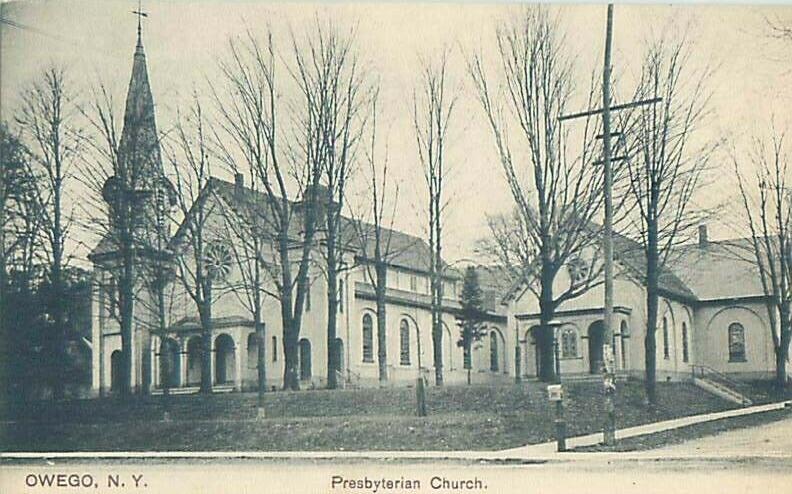
First Presbyterian Union Church
Sanctuary; front
90 North Ave.
Owego, NY, US
Instrument ID: 63730 ● Builder ID: 7897 ● Location ID: 55339
⬆️ These are database IDs that may change. Don't use as academic reference.EXPLORE IMAGESVIEW STOPLISTSomething not quite correct?Suggest an Edit
Plenum Organ Company
🤝 Instrument entries in New York sponsored by:
We are grateful for the generous support of our sponsors, who make it possible for us to continue our mission of preserving and promoting the rich history of pipe organs across the globe.

IMAGES
Category:
Only show images in a specific category ☝️
Something missing or not quite correct?Add ImageorSuggest an Edit
STOPLISTS
Selected Item:
View additional stoplist entries if they exist ☝️
Something missing or not quite correct?Add StoplistorSuggest an Edit
CONSOLES
Selected Item:
View additional console entries if they exist ☝️
Builder: Unknown
Position: Unknown
Design: Unknown
Pedalboard Type: Unknown
Features:
Stop Layout: Unknown
Expression Type: Unknown
Combination Action: Unknown
Control System: Unknown or N/A
Something missing or not quite correct?Add ConsoleorSuggest an Edit
DETAILS
Switch between notes, documents, and blowers ☝️
This instrument is: Not Extant and Not Playable in this location
Scot Huntington on March 26th, 2022:
In April 1964, Hillgreen contracted to add a 3-stop, 5-rank Echo with electric action, in the rear balcony.
In April 1964, Hillgreen contracted to add a 3-stop, 5-rank Echo with electric action, in the rear balcony.
Scot Huntington on March 26th, 2022:
This was an unusually detailed contract. In addition to the standard single-page Hillgreen boiler plate, this contract had 6 pages of typed specifications-- every detail of the contract, construction, and acceptance requiring the approval of the church's consultant, one G.F. Doring of New York City. The specifications if followed, would have yielded an instrument of a quality more deluxe than the usual Hillgreen factory standard. Excerpts are as follows: - All plans for the layout, including the design of the electric action (unknown meaning, it was tubular) had to be submitted for the approval of the agent before construction could begin. -The low 12 of the Diapason were to be used in the front, with blank pipes as needed; gilded in Dutch Gold (a gold-appearing composite containing no gold, but which tarnished), "protected with French varnish (a thin, clear shellac), or a similar lacquer". - An entrance through the case for the choir, to the vestibule. The case to be of black walnut (oak was crossed out and walnut written in pen". - Tubular-pneumatic action, key resistance 3.5 ounces, keys of ivory and ebony, action to have a rapidity to meet any demand. "Tubes of brass from key to chest" crossed out. - Chest of "clear white pine", individual-valve type, penumatics covered in the best quality sheepskin skiver. - Bass pipes of best quality, heavy annealed zinc. In pen: all zinc basses to have tuning inserts of spotted metal. All pipes below tenor-c except stopped flutes, to be full length and open. All other pipes of a tin and lead alloy appropriate to the desired tone. Wood pipes of best clear white pine, Pedal Bourdon of 'white wood'. - Stop action is drawknobs on each side of the keyboards, couplers by tilting tablets over the top keyboard. Crescendo pedal to be adjustable so any stops not desired to be affected by the pedal can be disconnected from it. Combination action to be adjustable and visible move the stops. Couplers and suitable pedal stops to be affected when desired. Stops can be set to not be affected by the combination pistons, so the desired stop may be set by hand and not affected with the combination pistons are used. Pedal keys to be concave and radiating. - Floor frame to be extra heavy with vertical structural members of heavy well-seasoned wood. Ample space shall be provided for access to all parts of the instrument for servicing. - An "Orgoblo" electric blower of sufficient capacity to keep the two reservoirs inflated under amu degree of demand. A pen annotation stated: "blower to be located a sufficient distance from the auditorium so as to avoid any unpleasant noises". Also appended in pen: "Tremolo to be noiseless and adjustable". - Swell enclosure to be made of heavy material framed together, as tall as the chamber will permit. Vertical swell shades swing on metal pins on metal seats. Shades of not less than 1 3/8" thickness of clear white pine glued up in 3 or 4 strips, tight fitting when closed. Swell pedal to be mechanical, so fitted as to avoid lost motion and clicking. Enough space between Swell and Crescendo pedals to avoid interference by either. The stoplist goes into details of construction for each stop, duplicating what is said in the specification section, but no details of consequence.
David Lenington on February 3rd, 2022:
Hillgreen-Lane organ had been dispersed per conversation with David Jackson in 2022. David Lenington 2-3-22
Database Manager on March 16th, 2019:
This entry describes an original installation of a new pipe organ. <br>Identified by David Lenington, who gave this as the source of the information: The Waverly Free Press and Tioga County Record,.<br>Purchase date: 1914.
Related Instrument Entries: Hillgreen, Lane & Co. (Opus 1254, 1964)
Something missing or not quite correct?Add NoteorAdd WebpageorAdd Cross ReferenceorSuggest an Edit
Pipe Organ Database
A project of the Organ Historical Society Website by John RoperEditor Login