Geo. Stevens (& Co.)
1853ca.
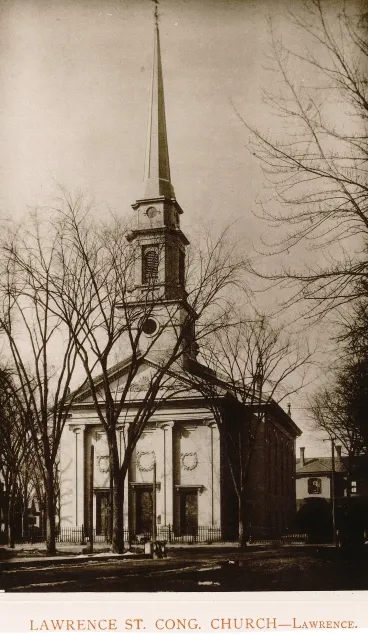
Lawrence Street Congregational Church
Lawrence and Haverhill Streets
Lawrence, MA, US
22 Ranks - 972 Pipes
EXPLORE IMAGESVIEW STOPLISTSomething not quite correct?Suggest an Edit
🤝 Instrument entries in Massachusetts sponsored by:
We are grateful for the generous support of our sponsors, who make it possible for us to continue our mission of preserving and promoting the rich history of pipe organs across the globe.

IMAGES
Something missing or not quite correct?Add ImageorSuggest an Edit
STOPLISTS
| GREAT | ||
| 8' | Open Diapason | |
| 8' | Dulciana (TG) | |
| 8' | Clarabella (TG) | |
| 8' | St. Diapason Treble (TG) | |
| 8' | St. Diapason Bass | |
| 4' | Principal | |
| 4' | Flute | |
| 2⅔' | Twelfth | |
| 2' | Fifteenth | |
| III-II | Sesquialtra | |
| 8' | Cremona (TG) |
| SWELL | ||
| 16' | Bourdon (TF) | |
| 8' | Open Diapason (TF) | |
| 8' | Viol de Gamba (TF) | |
| 8' | St. Diapason (TF) | |
| 8' | Swell Bass | |
| 4' | Principal (TF) | |
| III-II | Cornet (TF) | |
| 8' | Hautboy (TF) | |
| Tremolo |
| PEDAL | ||
| 16' | Sub Bass |
| Couplers | ||
| Couple Pedals Gr. & Sw. | ||
| Couple Great & Swell |
Something missing or not quite correct?Add StoplistorSuggest an Edit
CONSOLES
No console details are available. If you have information, please consider sharing it with us.
Something missing?Add Console
DETAILS
This instrument is: Not Extant and Not Playable in this location
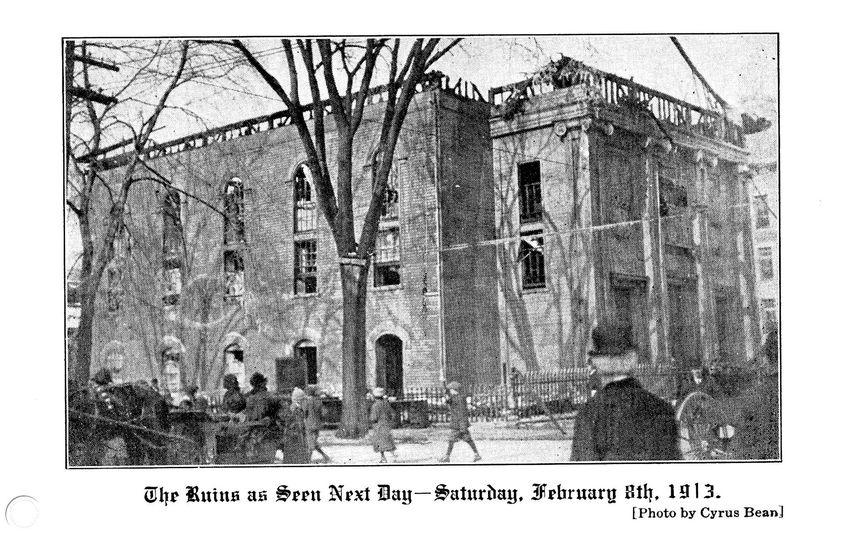
This wooden church was destroyed by fire in 1912 and replaced with the yellow/gold stone building in 1915 which still occipies the same plot of land at the corner of Haverhill and Lawrence Streets. The building is Iglesia de Dios.
Paul R. Marchesano on March 17th, 2022:
Known from notes on the relocated organ (to Chatham, Massachusetts) in the 1966 OHS Handbook:
The organ was built for the Lawrence Street Congregational Church, Lawrence, Massachusetts shortly after George Stevens adopted Ccompass, and was apparently moved to Chatham by Charles A. Ryder in 1893. Ryder installed a pedal keyboard of more modem design, but the compass and "repeating" action is original. The large five-sectional pine case is fake-grained to imitate rosewood, and though now in a recess, the side panels are intact. The recessed console is covered with sliding doors and the stops for the Great and Pedal are on the left jamb. There is a spare stop action and toeboard for the provision of an additional stop in each manual division - probably intended for Trumpet ranks. The unenclosed Swell Bass of stopped wood pipes is on a slider chest behind the Great and the Swell is above, behind horizontal shades. The open wood pedal pipes are at the rear. The pedal coupler has a notched shank, and the first positi'on brings on the Swell to Pedal; the second position cancels that coupler and brings on the Great to Pedal. The three lowest Open Diapason basses are offset within the case; the Great Stopped Diapason is of wood; the Flute is chimney, the lowest 12 being of stopped wood and the top 8 of open metal; the Cremona i's a small-scale Clarinet with straight resonators and 8 flue trebles. The Swell flutes are of stopped wood and the Hautboy has 8 flue trebles. The Sesquialtra is pitched at 17-19-22; 12-15-17; 12-15. The Cornet is 12-15-17; 12-15.
Webpage Links: Queen City MA
Related Instrument Entries: Andover Organ Co. (Opus R-36, 1964) , George Bozeman Jr., & Co., Organbuilders (Opus 52, 1992)
Something missing or not quite correct?Add NoteorAdd WebpageorAdd Cross ReferenceorSuggest an Edit