C. F. David Legge
1973-1980
Originally Breckels & Matthews Organ Co. (1906)
St. Mary Magdalene Anglican Church
477 Manning Avenue
Toronto, ON, CA
58 Ranks
EXPLORE IMAGESVIEW STOPLISTSomething not quite correct?Suggest an Edit
IMAGES
Something missing or not quite correct?Add ImageorSuggest an Edit
STOPLISTS
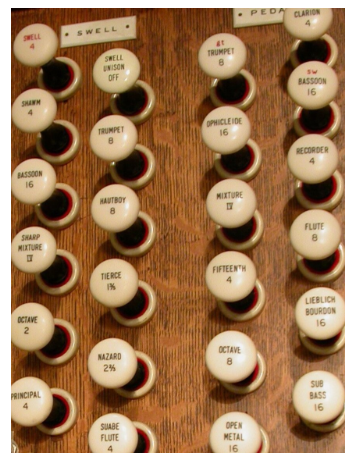
| I. CHOIR ORGAN | ||
| 8' | Gedackt | |
| 8' | Dulciana | |
| 8' | Unda Maris | |
| 4' | Chimney Flute | |
| 2' | Spire Principal* | |
| 1⅓' | Larigot* | |
| ½ | Cymbal III* | |
| 8' | Cremona | |
| 8' | Tuba | |
| Tremulant | ||
| Choir 16, 4 |
| II. GREAT ORGAN | ||
| 16' | Double Open Diapason | |
| 8' | Open Diapason I | |
| 8' | Open Diapason II | |
| 8' | Stopped Diapason* | |
| 8' | Gamba | |
| 4' | Octave | |
| 4' | Nason Flute* | |
| 2⅔' | Twelfth | |
| 2' | Fifteenth | |
| 1⅓' | Mixture IV* | |
| 8' | Cornet V* | |
| 8' | Trumpet* | |
| 4' | Clarion* | |
| Great 4 |
| III. SWELL ORGAN | ||
| 16' | Lieblich Bourdon | |
| 8' | Stopped Diapason | |
| 8' | Salicional | |
| 8' | Viola da Gamba | |
| 8' | Vox Angelica | |
| 4' | Principal | |
| 4' | Suabe Flute | |
| 2⅔' | Nazard | |
| 2' | Flageolet | |
| 1⅗' | Tierce | |
| 1' | Sharp Mixture IV* | |
| 16' | Bassoon* | |
| 8' | Trumpet† | |
| 8' | Oboe† | |
| 4' | Shawm† | |
| Tremulant | ||
| Swell 16, 4 |
| PEDAL ORGAN | ||
| 32' | Sub Bourdon | |
| 16' | Open Metal | |
| 16' | Open Wood | |
| 16' | Subbass | |
| 16' | Lieblich Bourdon | |
| 8' | Octave | |
| 8' | Flute | |
| 4' | Fifteenth | |
| 4' | Recorder | |
| 2⅔' | Mixture IV* | |
| 16' | Ophicleide† | |
| 16' | Bassoon | |
| 8' | Trumpet | |
| 4' | Clarion |
Something missing or not quite correct?Add StoplistorSuggest an Edit
CONSOLES
Builder: Unknown
Position: Unknown
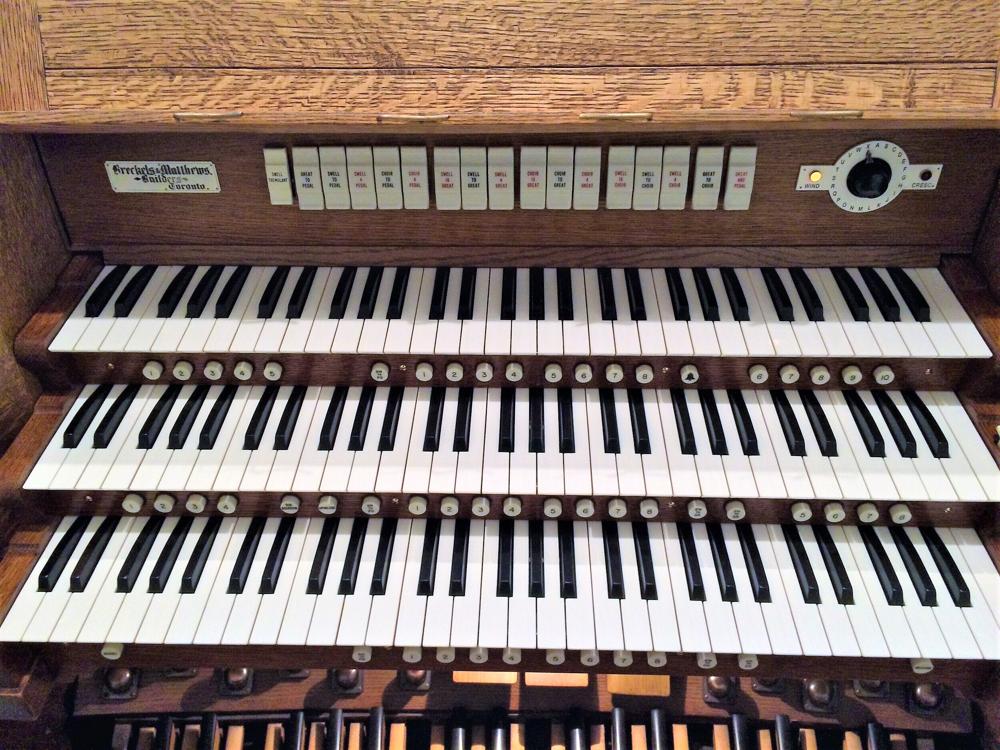
Design: Traditional With Roll Top
Pedalboard Type: Concave Radiating (Meeting AGO Standards)
Features:
3 Manuals (61 Notes)32 Note Pedal4 Divisions43 Stops50 RegistersStop Layout: Unknown
Expression Type: Unknown
Combination Action: Unknown
Control System: Unknown or N/A
Something missing or not quite correct?Add ConsoleorSuggest an Edit
DETAILS
Exhibited in the 2023 OHS convention(s)
This instrument is: Extant and Playable in this location
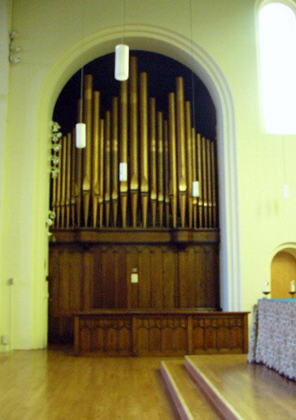
Healey Willan, who is revered by this church to this day, expressly wanted no changes made to his organ at the time of his death, and was very upset at the neo-classicization of his old instrument at St. Paul's, Bloor Street in 1956. Far from being a "British" instrument, it was simply of a very standard and conservative Canadian style at the time, only a bit more adventurous than Charles Sumner Warren's instruments of a few years prior and not nearly as progressive and British as Casavant would become in the next decade. Nonetheless, the instrument was heavily modified following his death and re-dedicated as his organ despite the fact he would not have approved of any of the work. Most of the principal chorus was re-scaled and de-nicked quasi-automatically (as was done at St. James by the same people only a few years prior), the original reeds were re-voiced and new ones added not in the character of the original (the Warren 16' reed from St. Andrew's was altered to such an extent that it no longer sounds like one of that era, let alone from that builder), characteristic Romantic stops were replaced with unblending mixtures and mutations that do not make sense in context, and the expressive wind system of the original was swapped for completely solid Schwimmer wind. The level of intervention has been hidden from the public and is partially veiled by the very generous acoustic and placement of the organ. Nonetheless, one can detect the vestiges of an instrument originally of great Romantic beauty. Despite being the only instrument in Toronto with a preponderance of Breckels & Matthews pipework, and much of it being fairly easy to return to its original state, the church is not financially healthy and there is no money for the restoration which the organ deserves.
Visited late 2024, verified details with two builders who personally worked on the instrument.
Paul R. Marchesano on July 21st, 2023:
The organ at the Church of St. Mary Magdalene was built in 1906 by the Toronto firm of Breckles and Matthews, and originally contained around 27 stops. The firm was founded in 1900 by two workers from the D.W. Karn company of Woodstock, Ontario.
In 1931 the action of the organ was electrified, and the console was moved to the gallery under Healey Willan’s direction so that he could both play and conduct the choir. The Tuba rank, which speaks directly into the St. Joseph’s chapel, was also installed during Willan’s tenure, but apart from that the organ retained its original voice until after Willan’s death. By that time the instrument needed a thorough restoration; a complete rebuild, enlargement and modernisation of the organ was carried out.
Today the organ is much larger, having grown to 51 stops. The work was started in the early 1970’s by David Legge and Willan’s successor Giles Bryant. Additional work was carried out by Alan T. Jackson and company, the local Casavant representatives, and in 1980 the organ was rededicated as the Healey Willan memorial organ. Casavant windchests were provided throughout the instrument, except for the separate pedal Subbass and Open Wood chests, which remain original. New pipes (marked with an asterisk in the specification below) were provided by the Casavant factory in St. Hyacinth Quebec, and some second-hand material was used to form other new stops from the Warren organ dismantled at St. Andrew’s Presbyterian Church on King Street. Some of the original pipework was revoiced, but much of it still speaks with its original and very British sounding character.
The console was rebuilt in 2017 by John Struve with new keyboards of exceptional quality from P&S in Suffolk, England, and a new memory level system was added. The electrical relay, which had become sluggish and unreliable with age, was replaced with a new solid-state system, refining the playing capabilities of the instrument immensely.
-- Church website
Paul R. Marchesano on July 21st, 2023:
Around 1906 Breckels & Matthews built a pneumatic-action chancel organ of about 29 ranks. Acting on Willan’s request, in 1931 L.E. Morel electrified the action and moved the console to the gallery. Later came the addition of an English-built Tuba at 16ʹ–8ʹ–4ʹ, and Franklin Legge unified the Choir Flute to sound also at 4ʹ pitch. The Healey Willan Memorial Fund was established in 1971, and a rebuilding of the organ began that same year under the organist Giles Bryant. The initiative drew upon volunteer help and the builder David Legge. The renovations proceeded from 1973 to 1980 using Casavant chests and pipes. Installation and tonal finishing were by Alan T. Jackson, who worked on a time basis to allow for a diminishing volunteer force.
-- 2023 OHS Handbook
Something missing or not quite correct?Add NoteorAdd WebpageorAdd Cross ReferenceorSuggest an Edit