C. E. Morey
Opus 196, 1902
Originally Garret House (1867)
Congregational Church
Sanctuary; front
South Main Street
Warsaw, NY, US
18 Ranks
EXPLORE IMAGESSomething not quite correct?Suggest an Edit
IMAGES
Something missing or not quite correct?Add ImageorSuggest an Edit
STOPLISTS
No stoplist details are available. If you have stoplists, please consider sharing them with us.
Something missing?Add Stoplist
CONSOLES
Builder: Unknown
Position: Keydesk Attached, Manuals Set Into Case
Design: Traditional With a Keyboard Cover That Can Be Lifted To Form a Music Rack
Pedalboard Type: Flat Straight
Features:
2 Manuals (58 Notes)Mechanical (Unknown) Key ActionMechanical Stop ActionStop Layout: Drawknobs in Horizontal Rows on Terraced/Stepped Jambs
Expression Type: Balanced Expression Shoes/Pedals (Details Unknown)
Combination Action: Fixed Mechanical
Control System: Unknown or N/A
Something missing or not quite correct?Add ConsoleorSuggest an Edit
DETAILS
This instrument is: Extant and Playable in this location
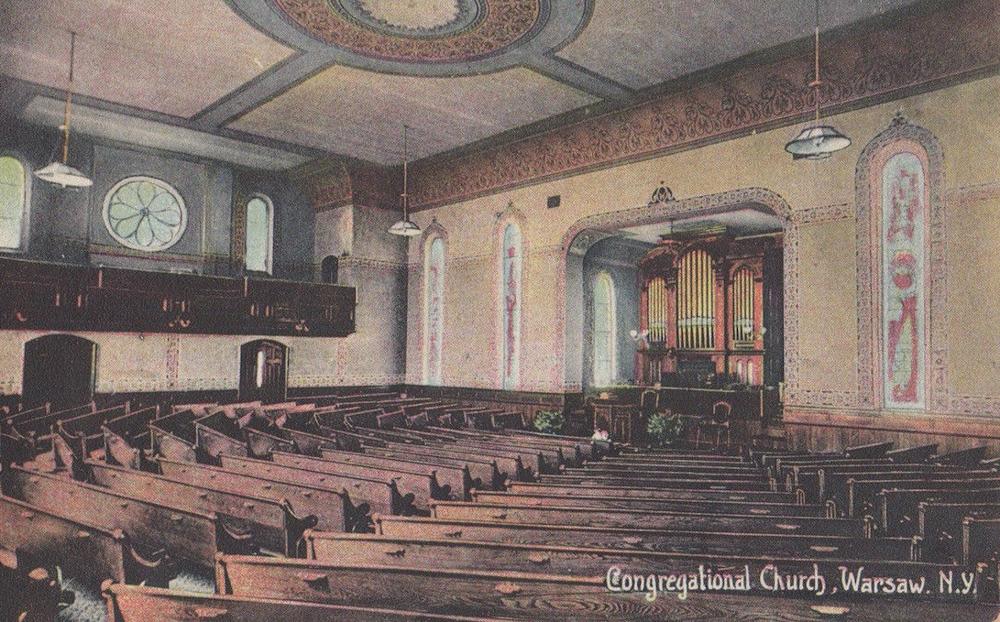
Looking at the images of the two side by side churches, the Presbyterian church with its tall and elegant spire is on the right, and the Congregational church on the left with the spiked tower is oriented with the altar on the long side, and the organ niche protruded from the left side of the building.
Scot Huntington on May 16th, 2021:
The 1866 brick church with the tall spire designed by the famed Rochester architect Andrew Warner on this site is the second building for this congregation, replacing a wood building constructed in 1808. The church website states the first organ for this congregation was installed in 1850, unfortunately unidentified.
Garret House installed a two-manual instrument in a front niche on the newly-constructed church in 1867. In 1902, C.E. Morey installed a two-manual organ inside the original House case. Whether this was a new organ or a rebuild of the House is presently unknown and requires further research. In 1944, this congregation merged with the Presbyterians in the church next door, also designed by architect Warner. A connector was built between the two buildings, and the Congregational church remained the prime meeting house. The Presbyterian sanctuary was heavily altered and made into a small chapel. Church facebook photos show the Johnson case in place, the top portion obscured by a dropped ceiling and a rank of pipes can be seen through the feet of the facade pipes. The Johnson console is gone.
A contemporary photo of the Congregational church shows a redesigned front and the niche formerly occupied by the Garret House case is empty and filled with something with the appearance of grills. The church has the typical array of drums and microphone stands, but the fate of the Morey or whether this church still has a real organ is yet to be determined.
Database Manager on December 26th, 2011:
Updated through online information from Michael Fraser. -- Entire swell division non functioning. Organ in need of complete rebuild.
Database Manager on October 28th, 2008:
Updated through on-line information from Michael Fraser. -- Church merged with Congregational church located next door. Buildings connected via walkway with office space. Church building now used as chapel. Drop Ceiling installed in sanctuary area covering top of organ case. Instrument in unknown condition.
Database Manager on October 30th, 2004:
Bldg was Presbyterian. [Presbyterian merged with Congregational & sold bldg.]
Something missing or not quite correct?Add NoteorAdd WebpageorAdd Cross ReferenceorSuggest an Edit