S. L. Huntington & Co.
1990
Dartmouth College
29 College Street
Hanover, NH, US
5 Ranks - 238 Pipes
EXPLORE IMAGESVIEW STOPLISTSomething not quite correct?Suggest an Edit
IMAGES
Something missing or not quite correct?Add ImageorSuggest an Edit
STOPLISTS
| Manual | ||
| [8] | Open Diapason treble (TF) | |
| [8] | Stopt Diapason | |
| [4] | Principal | |
| [2⅔] | Great Twelfth treble (TC) | |
| [2] | Fifteenth | |
| [2⅔] | Small Twelfth bafs |
Something missing or not quite correct?Add StoplistorSuggest an Edit
CONSOLES
Builder: Unknown
Position: Unknown
Design: Unknown
Pedalboard Type: Unknown
Features:
1 ManualsStop Layout: Unknown
Expression Type: Unknown
Combination Action: Unknown
Control System: Unknown or N/A
Something missing or not quite correct?Add ConsoleorSuggest an Edit
DETAILS
This instrument is: Extant and Playable in this location
S. L. Huntington & Co. Portativ, Stonington, CT, 1990 Opus,
1 manual, 4-1/2 ranks, mechanical action throughout, with transposing keyboard;
[box-Positiv Continuo pipe organ, custom design and construction, solid cherry casework]
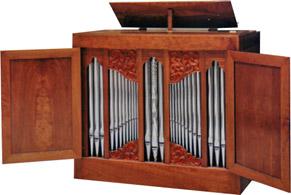
A portable chamber organ, housed in a handsome paneled case of antiqued cherry with a façade of pure tin diapasons and hand carved acanthus leaves. Keyboard compass C-d’’’, 51 notes, playing at either 415 or 440, easily transposable. The keyboard is high enough to be played comfortably while standing and conducting, yet low enough to allow the player to see the conductor over the music rack whilst seated. All the interior pipework is of Sitka spruce for lightness, durability, and that special late 17th, early 18th century English sound. The scaling and voicing is reminiscent of the work of Smith, Bridge and Snetzler. The Open Diapason commences at tenor f whilst the other four stops divide into treble and bass between middle c and c sharp at 415, b and c at 440. The blower is self-contained and in its own case. -- from Czelusniak et Dugal, Inc. website
Database Manager on November 13th, 2014:
This entry describes an original installation of a new pipe organ.
Identified by John Igoe, using information from this web site: http://slhorgans.com/slh05.html.
Something missing or not quite correct?Add NoteorAdd WebpageorAdd Cross ReferenceorSuggest an Edit